LC3 Grande Confort Lounge Chair
c. 1929/1965

Inquire or Request
- Regarding
-
LC3 Grande Confort Lounge Chair
by Charlotte Perriand , Pierre Jeanneret , Le Corbusier
Designed in 1929 by Le Corbusier, Pierre Jeanneret, and Charlotte Perriand, the LC3 Grande Confort Lounge Chair has been produced by Cassina since 1965. The design is defined by an external tubular steel frame, finished here in taupe grey, which acts as a cage for a separate upholstered volume. This structural logic creates a literal distinction between the load-bearing metal support and the soft elements of the seat.
The chair contains four loose cushions — seat, back, and two arms — filled with feather and encased in dark green Grade ZZ glove leather. Unlike traditional armchairs where the frame is concealed, the LC3 exposes its skeleton, allowing the cushions to be held in place solely by the tension of the steel. This specific example remains in excellent condition, reflecting the technical precision and material contrast central to the authors’ collaborative pursuit of “equipment for living.”
One in stock, like new.
Image Gallery


Charlotte Perriand
France
Charlotte Perriand believed that good design began not with form, but with life. Born in Paris in 1903, she came of age during the rise of modernism but never accepted its austerity at face value. After studying at the École de l’Union Centrale des Arts Décoratifs, she caught Le Corbusier’s attention with her Bar sous le Toit installation—an aluminum and glass interior that announced a new language for domestic space.
Perriand spent her career expanding that language, insisting that interiors could be democratic without losing their sensuality. Her collaborations with Le Corbusier and Pierre Jeanneret shaped the furniture of the machine age, yet her later work—wooden chaises, woven stools, modular shelving—revealed an intimacy modernism often forgot.
From the mountains of Savoie to postwar Japan, she treated design as both a social and material experiment. Wood, metal, bamboo—each was used for its honesty, its human touch. Today, Perriand’s work feels less like a relic of modernism than a quiet blueprint for how to live well: rigorous, humane, and always unfinished in the best sense.

Pierre Jeanneret
Switzerland
Pierre Jeanneret’s practice was defined by a career-long engagement with modernist principles, initially developed alongside his cousin, Le Corbusier. After training at the École des Beaux-Arts in Geneva, Jeanneret joined the Paris studio in the early 1920s, where he contributed to the development of standardized architectural forms and tubular steel furniture. His work during this period focused on the application of industrial methods to domestic and civic environments.
In the postwar era, Jeanneret’s role shifted toward the administrative and structural oversight of Chandigarh, India’s new capital. Residing on-site for fifteen years, he designed a comprehensive body of furniture for the city’s institutional buildings. These pieces—constructed primarily from local teak and cane—are characterized by robust, V-shaped geometries and simple joinery adapted to regional craft capabilities. Pierre Jeanneret’s output remains a significant record of the transition from European modernism to a pragmatic, site-specific functionalism rooted in material economy and local production.

Le Corbusier
Switzerland
Le Corbusier, born Charles-Édouard Jeanneret, defined the trajectory of architectural modernism. His practice was grounded in a program of standardization and the application of industrial logic to the domestic sphere. By the late 1920s, he had codified his methodology into the "Five Points of a New Architecture," a system that emphasized structural independence and the liberation of the floor plan.
His collaboration with Charlotte Perriand and Pierre Jeanneret extended these architectural principles to furniture, utilizing tubular steel and modular components to create objects that functioned as "equipment" for living. In his postwar work, exemplified by the Unité d’Habitation, he moved toward the use of béton brut, or raw concrete, emphasizing the tactile and sculptural weight of the material. Throughout his output, Le Corbusier maintained a focus on proportion and the social implications of design, positioning the built environment as a precise technical response to the requirements of the twentieth century.
Charlotte Perriand
Pierre Jeanneret
Le Corbusier
More in Interiors
View All
Gamar Chair
by Spacon & X
for e15

Shahnaz Sideboard
by Philipp Mainzer
for e15

Fawley Bench
by David Chipperfield
for e15
More in Charlotte Perriand
View All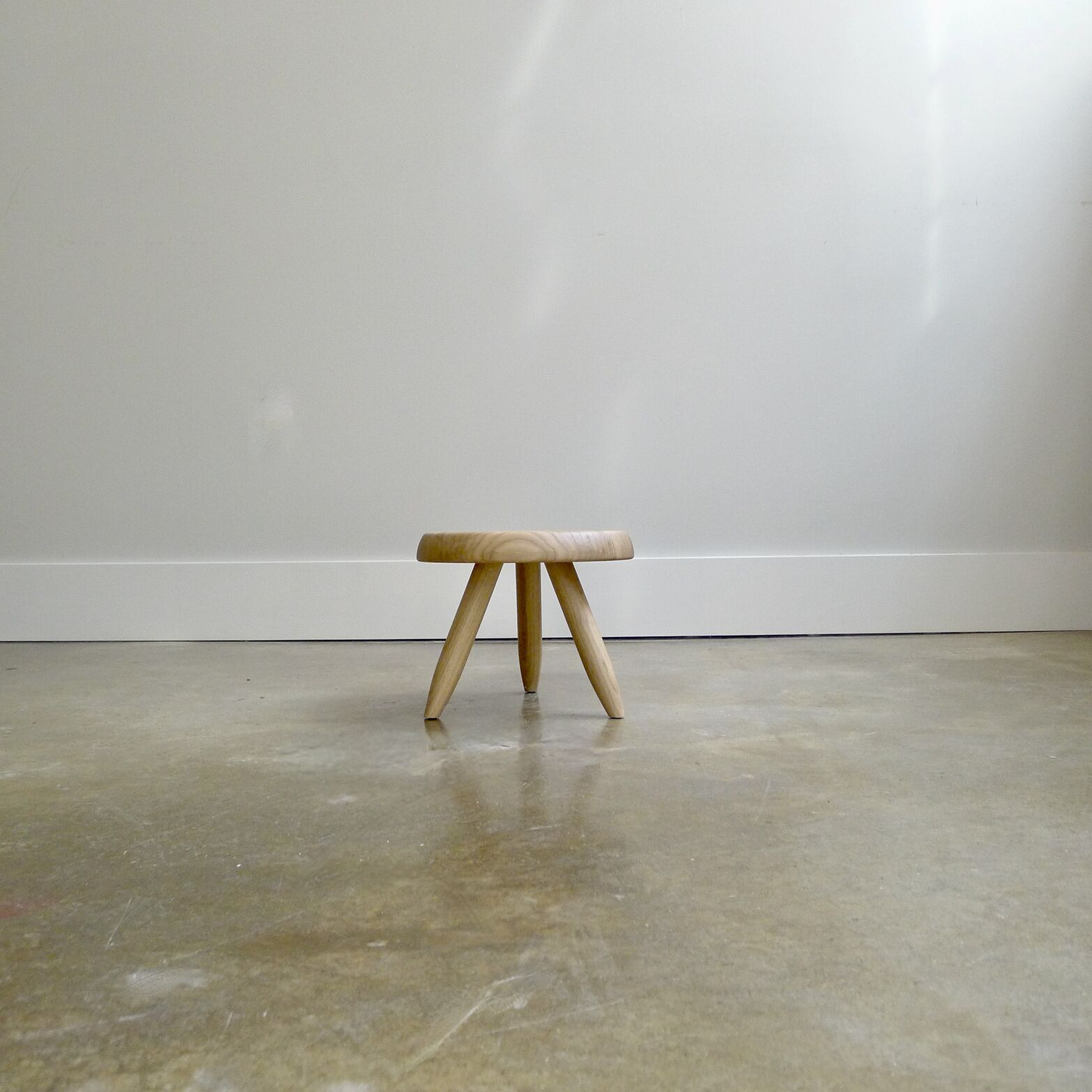
Tabouret Berger Stool
$759

Charlotte Perriand Low Coffee Table
by Charlotte Perriand , Jean Prouvé

Appliqué Cylindrique Petit
$677